



Blind Radius II
By Elizabeth Fortescue – Arts Editor – The Daily Telegraph
Arts Editor Daily Telegraph, Australian correspondent The Art Newspaper
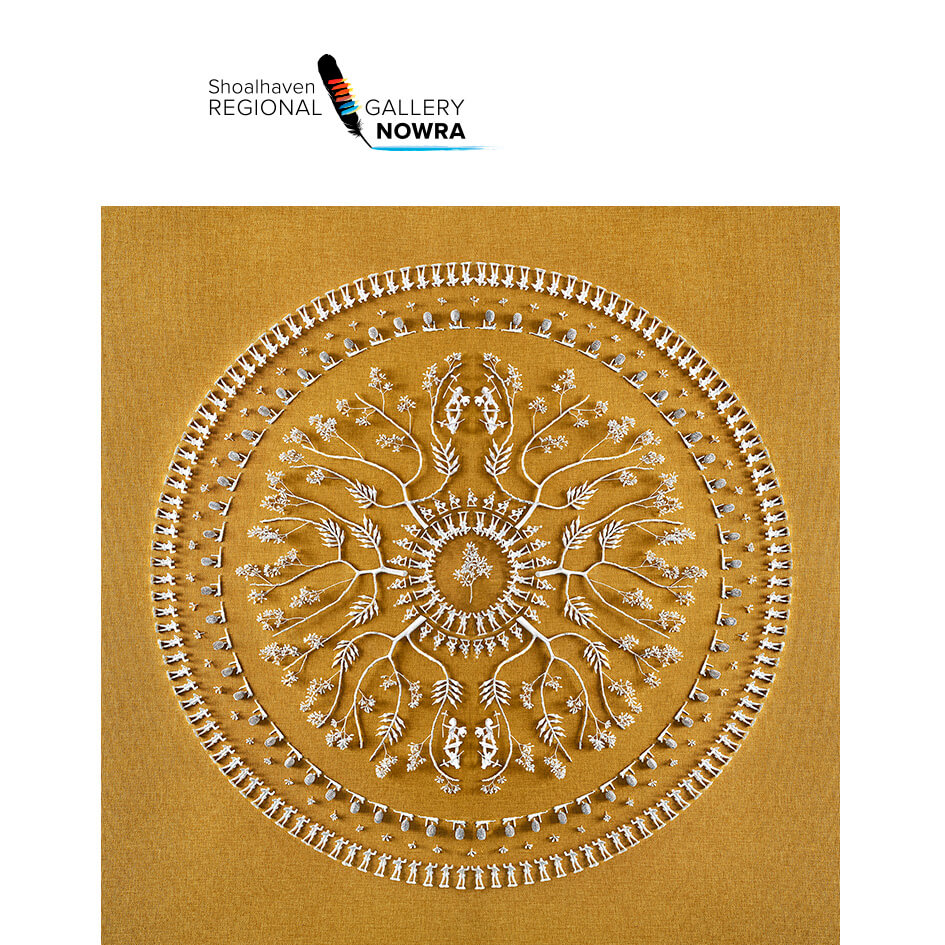
Aren’t they lovely, these beautiful, mandala-like photographs of Sally McKay’s? Doesn’t their intricacy and delicacy whisk you back to grandma’s house and all the comfort and reassurance that you once found among her handmade doilies and tapestries?
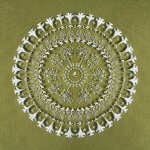
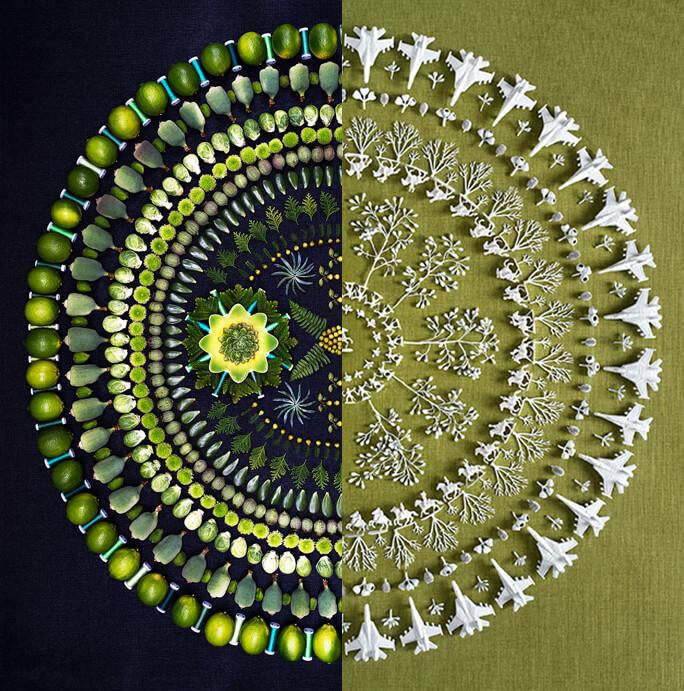
Come a little closer. What do you really see? Plastic gures with plastic guns. Plastic observation towers. Plastic fighter jets and plastic tanks. All arranged in the neatest of circles, all chasing one another endlessly round and round the mandala with their rifles raised, each figure in the sights of the one behind.
Sally McKay calls it “war plastic”, and the supply of it never ends. The figurines, forever frozen in their puddles of plastic, were ubiquitous in the Australian childhood. They’re still churned out in factories, and children the world over still use them to stage mock battles. But this is 2018, and now the toys come with a choke hazard warning. Pity the sea creatures who can’t read those warnings, and die in their millions because of various types of floating plastic waste.
McKay is by training, practice and inclination a photographer, and the artworks on view here are photographs. But the last few years have seen McKay’s process veer towards a whole new way of working. McKay creates installations on platforms in her studio, using tweezers to painstakingly arrange objects in a circular pattern. She finds these circles “holistic”, and some of her admirers have likened them to mandalas. It’s a comparison she doesn’t dislike.
In a previous series, exhibited at .M Contemporary in October 2017, McKay assembled and photographed circular installations made of oddments both manmade and natural, creating colour harmonies that she intended to open our eyes to the beauty in everyday objects that we often take for granted.
In this new series, Blind Radius II, McKay goes further. She wants us to see beauty in all these lace mandalas. But she also wants us to be confronted by their components. But these components are not exclusively plastic. McKay also collected dead plant material from the floor of the mini forest in Cooper Park near her family home in Sydney’s east. She enjoys referring to nature in her work.
“I wanted to show the link between plastic and what happens with our environment,” she says.
In McKay’s work, the plastic and the vegetation are all painted white and arranged on coloured woven cotton in nine pretty colours from watermelon to egg yolk to slate blue. They are then photographed, and printed.
McKay’s influences in these works are varied. Her childhood plays a big role. Her father Peter Linley owned and ran a Melbourne company called Interprint which printed catalogues and posters for the National Gallery of Victoria, and did printing for photographers. It was Peter who gave McKay her first camera when she was 12.
Antique French lace is an obvious influence. And McKay has looked to several international artists – Indian-born Raqib Shaw, China’s Yao Lu and Michael Wolf of Germany. The works of Shaw and Yao Lu look beautiful for a minute, before you realise what you’re actually looking at. Shaw’s decadently coloured scenes of opulence and wealth feature flayed bodies and skeletons. Yao Lu’s photography appears to be of traditional Chinese mountain scenery before you realise those mountains are rubbish dumps. The photography of Michael Wolf takes us inside Chinese toy factories, where workers toil and sleep in squalid conditions to supply the global market with plastic objects of momentary, passing children’s play. In Wolf’s photography, piles of dolls’ heads awaiting assemblage are gruesome and repellently visceral.
So here is McKay’s second solo exhibition. Just like grandma’s house.
But watch out, Little Red Riding Hood, because grandma has grown some very big teeth.


Blind Radius I & II – The Intersection
By Clare Caldwell – The Authorial
Despite the discernible contrast between McKay’s bodies of work, it is clear that they share a unified message. Their joys and sobering realities ask the audience to ruminate on the impact of humanity on the natural environment. More importantly however, the works demand that the viewer observe what is both within and beyond their own radius so that they may, in the words of Thoreau, understand less but begin to see more.
Blind Radius I, 2017
In her first venture beyond portraiture, McKay undertook an assiduous process of collecting still life objects within her local radius, arranging and then photographing them in a series of meticulous curations of colour. “There is beauty around us that we don’t always experience. These works forced me to slow down, pause and forage,” she explains. Each piece is a homage to the Pantone scale, assembled in hypnotic concentric rings that intersperse items of urban bushland flora with fragments from her domestic setting. The images invite the viewer to come closer, look more critically and understand the works less as art and more as statements on our surroundings. “The juxtaposition of the elements is not random, they’re not accidents. They’re reflections, like a mirror,” says McKay. At first, the viewer may think they recognise the design of a Buddhist mandala in the amphitheatre of found objects that McKay has carefully devised. The familiar acquaintance evokes an intimacy with the work where humble, natural elements sit amongst the miscellany that feed the conversations and fabric of daily life. Teacups, plates and cotton reels mingle with the ephemera of the local landscape – petals, lush produce, fallen autumn leaves. The rhythm of these repeated elements, in cordons of perfectly elliptical lemons, lush hydrangeas and ripening acorns, focuses the audience on the particular, rather than the general. “The most rewarding part of showing my art,” explains McKay, “is seeing people come in close, right up to the glass, and suddenly noticing all the tiny elements that make up the whole.” When this occurs, she says, her art has done its work.
Blind Radius II, 2018
In McKay’s subsequent series, the dialogue is markedly different and asks the observer significantly more challenging questions. Her exceptional capacity to harness colour and light makes for a familiar scene, yet this time the works depict an intersection rather than a symbiosis – one where the natural world and the ‘fast’ economy collide. In these later images, McKay’s message carries weight and provocation, its power emanating from absence rather than abundance. Colour is forced to the background and stark white heroes take centre-stage. Where Blind Radius I had celebrated the rich palette of Australian ora, this later series presents a contrasting story. Part chiaroscuro, part silhouette, each incremental halo generates its own thought-provoking chapter on the often-dichotomous relationship between nature and humanity. “These works are about the non-beauty that surrounds us,” McKay explains. “They’re about environmental damage, about consumerism and the way we package up plastic to appear beautiful.”
From afar, her whimsical patterns take on the appearance of antique lace, but a careful inspection reveals that their dainty ornamentations are indeed dozens of model toy soldiers, figurines from archaic war games and their incumbent plastic artilleries, all frozen mid-pose. In these scenes, the antithetical elements of nature and warfare are disguised in a mutual cloak of alabaster depicting the precarious relationship between our environment and a profligate disposable economy.
In this space, McKay weaves her palette judiciously, right down to the ambiguous nomenclature she uses to speak of beauty. The works’ titles each derive from the French term for lace – dentelle – along with a seemingly synaesthetic reaction to their colour and context: Ardoise suggests the English word arduous, Bleuet conjures bullet, and Grenadine invokes grenade. These instances appear neither accidental nor deliberate, but simply an acknowledgement of the interdependence of colour and emotion in art and life.

M Contemporary Exhibition
Exhibition: September 23rd – October 10th
McKay’s exhibition celebrates the things that exist in our local environments that we see every day, yet are totally unaware of. The artist brings her unique perspective to these natural and wonderful objects, opening viewers’ minds to the beauty and mystery that surrounds us at all times – and that we can discover too if we only look hard enough. Read more here.


BIFB – Ballarat Photo Biennal
Sally McKay’s debut exhibition, The Blind Radius, celebrates the things that exist in our local environments that we see every day, yet are totally unaware of. The artist brings her unique perspective to these strange and wonderful objects, opening viewers’ minds to the beauty and mystery that surrounds us at all times — and that we can discover if we look hard enough.
DATE AND TIME
19 Aug – 17 Sep 2017
Sun–Mon 11am–6pm,
Tues–Wed 11am–9pm,
Thurs–Sat 11am–10pm
Read More about the Ballarat Foto Biennale exhibition here.
